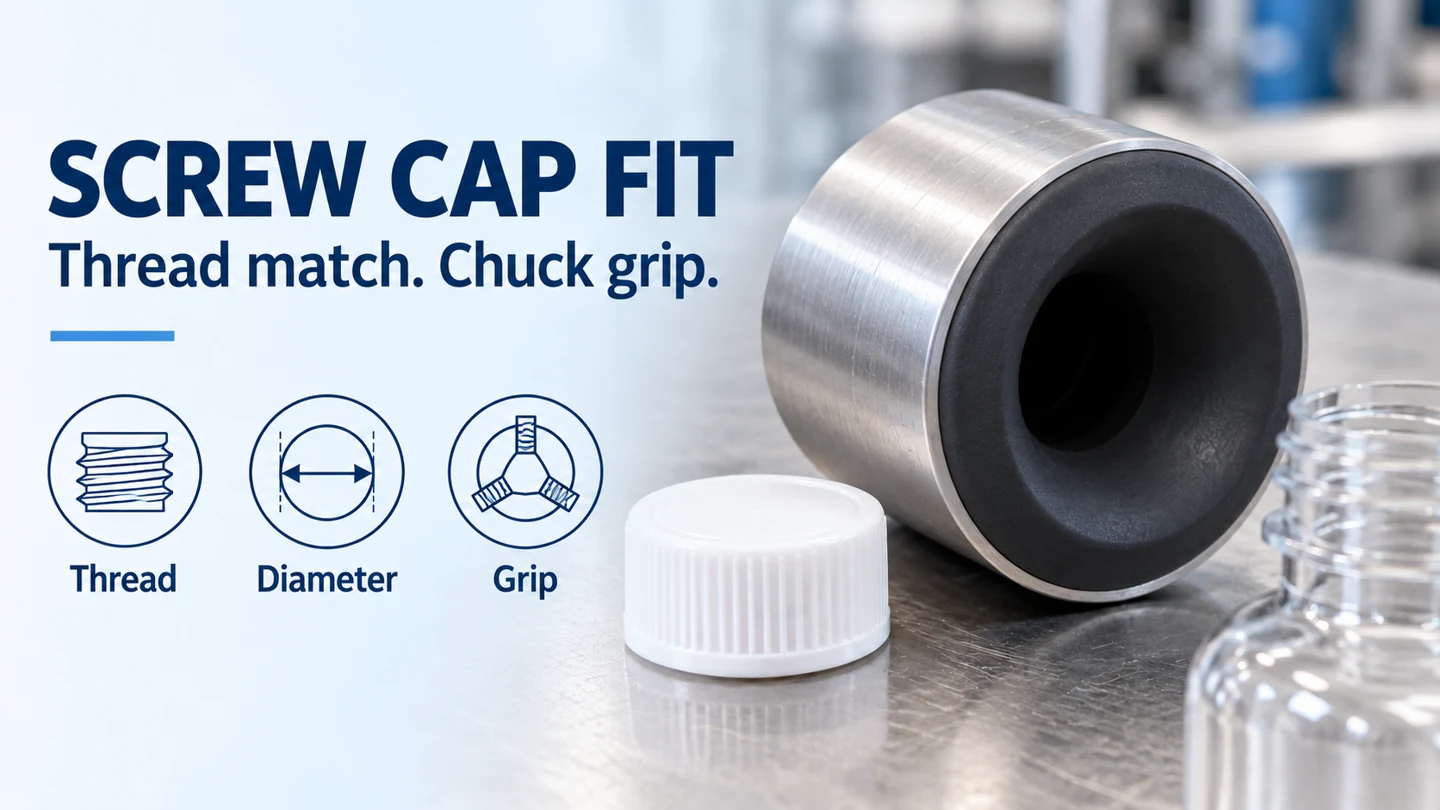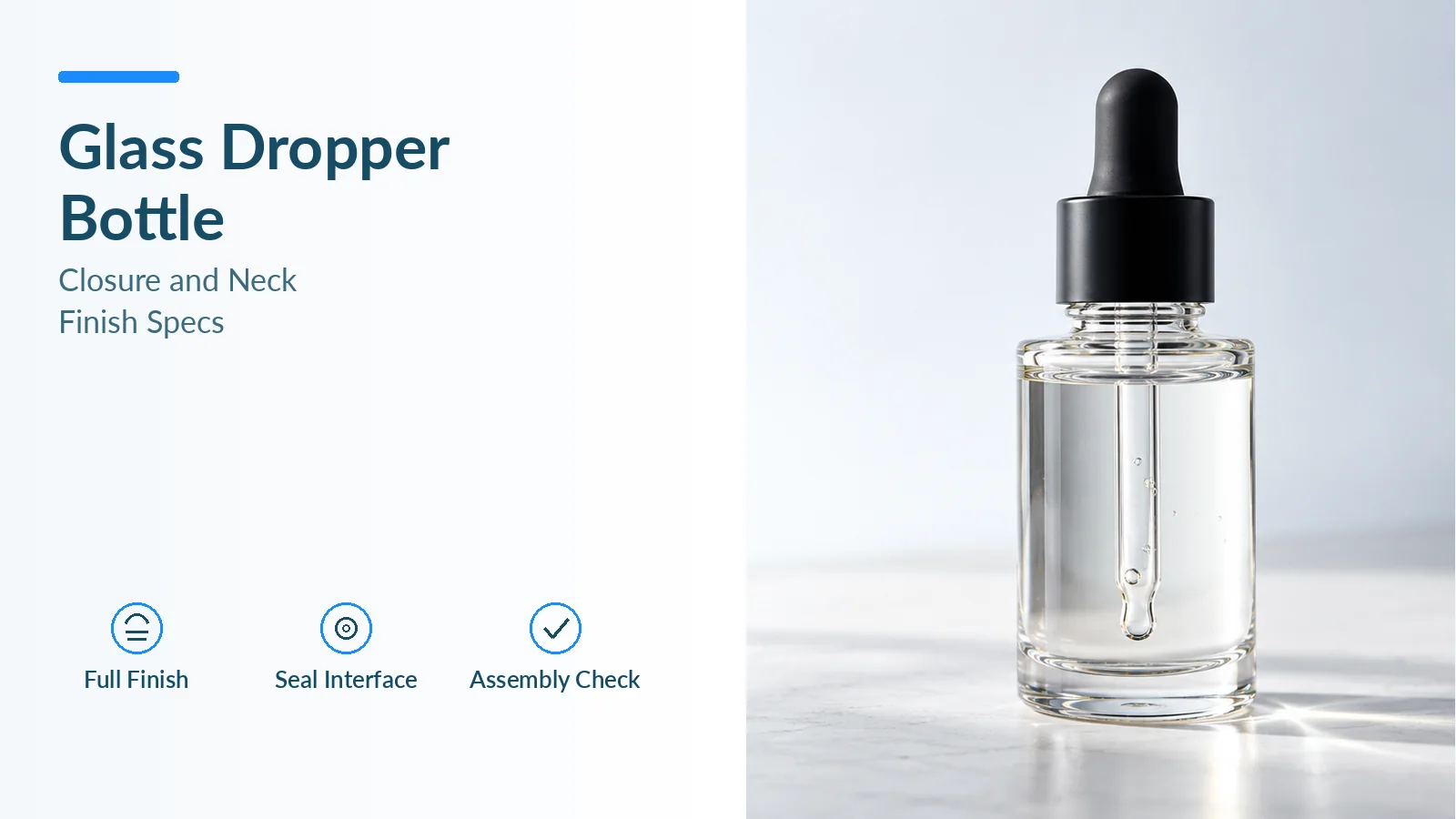
A cap that screws onto a bottle can still be the wrong closure for the package. Compare the full finish and the sealing design on paired drawings, then verify representative bottle and cap samples together.

A nominal diameter is only the starting point
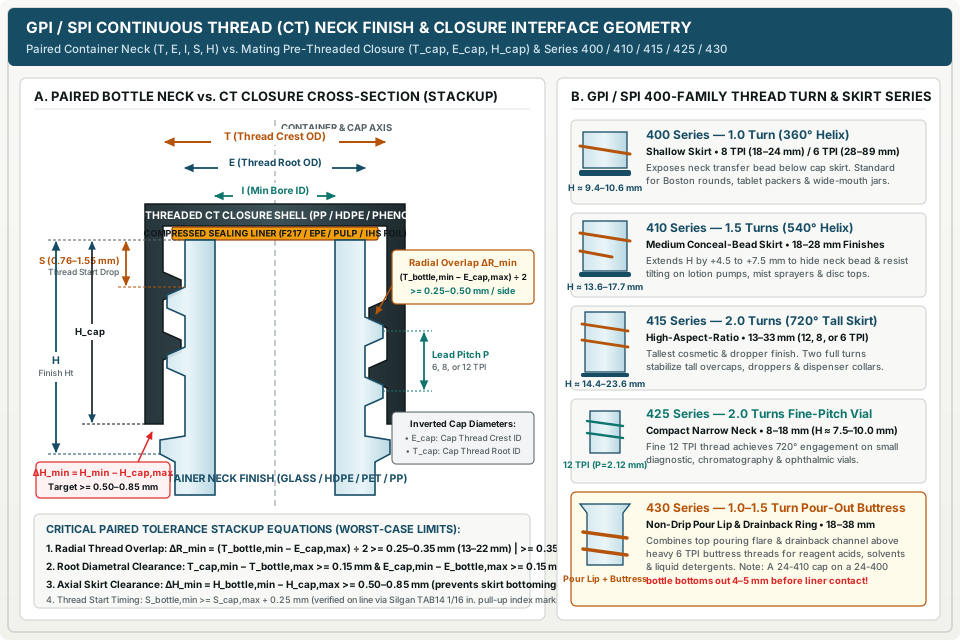
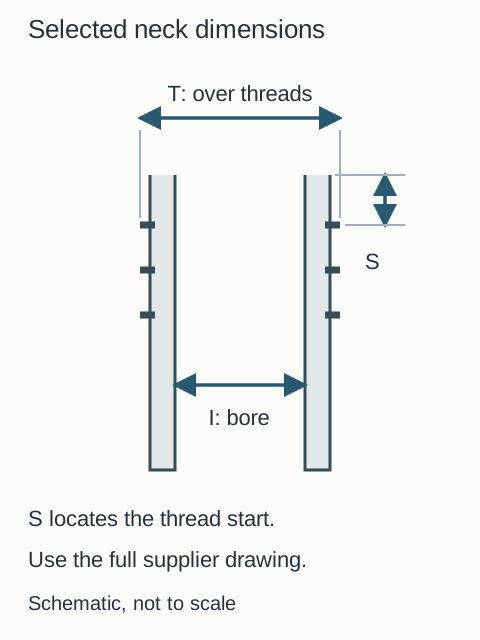
TricorBraun’s neck-finish guide says the bottle and closure need matching finishes. Its dimensional definitions distinguish the outside thread diameter, the internal bore and the location of the thread start. Those features answer different questions; a single outside measurement cannot replace them.
Treat a full finish code as an identification step. Obtain the supplier drawing for the actual bottle and the mating closure, including tolerances and revision. A supplier catalogue match helps narrow the candidates, but it does not settle whether a liner, plug seal or dispensing insert will work with the product and application process.
Read the drawings as a pair
Identify the closure’s sealing surface and the bottle surface it is intended to meet. Some designs depend on a liner against the rim; others use a feature entering the bore. Ask the closure supplier to identify the approved interface on the drawing. Do not assume that the thread itself provides the seal.
| Drawing check | Question to resolve | Evidence to retain |
|---|---|---|
| Full finish designation | Are bottle and closure intended to mate? | Both drawing references and revisions |
| Thread geometry | Do the intended thread forms and engagement agree? | Supplier confirmation of the drawing pair |
| Rim or bore seal | Which surfaces create the seal? | Closure section and bottle sealing-surface detail |
| Clearance | Can the liner, plug or insert seat without an unintended stop? | Relevant tolerances and assembled sample observations |
| Application | How is the closure gripped and driven? | Approved application instructions and trial setup |
TricorBraun labels T as the major outside span across the threads, I as the internal neck diameter and S as the distance from the finish top to the thread start. Use the terminology on your supplier’s drawing; if symbols differ, confirm the definition rather than translating a letter by guesswork.
Give samples a traceable identity
Keep the bottle and cap lot references attached to the trial. Retain the components before assembly as well as completed packages. A scuffed sealing rim, deformed thread or contamination can be lost in a verbal account of ‘the cap did not fit’. Record the position and appearance of the problem, with a photograph where possible.
Hand assembly can reveal an obvious mismatch, but it is not proof that a production capper will place and tighten the closure correctly. Trial the complete package under the intended operating conditions, using the current equipment and closure instructions. Record whether the cap starts squarely, reaches its expected position and opens as intended.

Avoid transferring a check across closure families
Wine packaging shows why the interface matters. A roll-on wine cap seals through its liner and requires a suitable glass finish and application head; a cylindrical cork uses the bottle bore. A bottle selected for one closure family should not be reassigned to the other because the neck looks similar. Our wine closure comparison describes the equipment implications.
For a screw-cap package, use the agreed torque test method together with the required sealing checks. When assembly goes wrong, preserve the sample before changing settings. Identify whether the failure began at placement, engagement or final closure.
Record a release decision with boundaries
Write the approval as a specific combination: bottle reference and revision, closure reference and revision, liner where applicable, application setup and test method. Record exceptions, who must resolve them and what change would require another evaluation. A new resin, supplier drawing or sealing insert may need a fresh review even when the nominal finish stays the same. For numeric GPI/SPI 400, 410, 415, 425, and 430 series tables, T/E/I/S/H tolerance stackup equations, and L-style versus M-style thread profiles, see Continuous Thread Closure Dimensions: GPI/SPI 400, 410, 415 & 425 Specs, or explore the bottle neck finishes guide for related decisions.