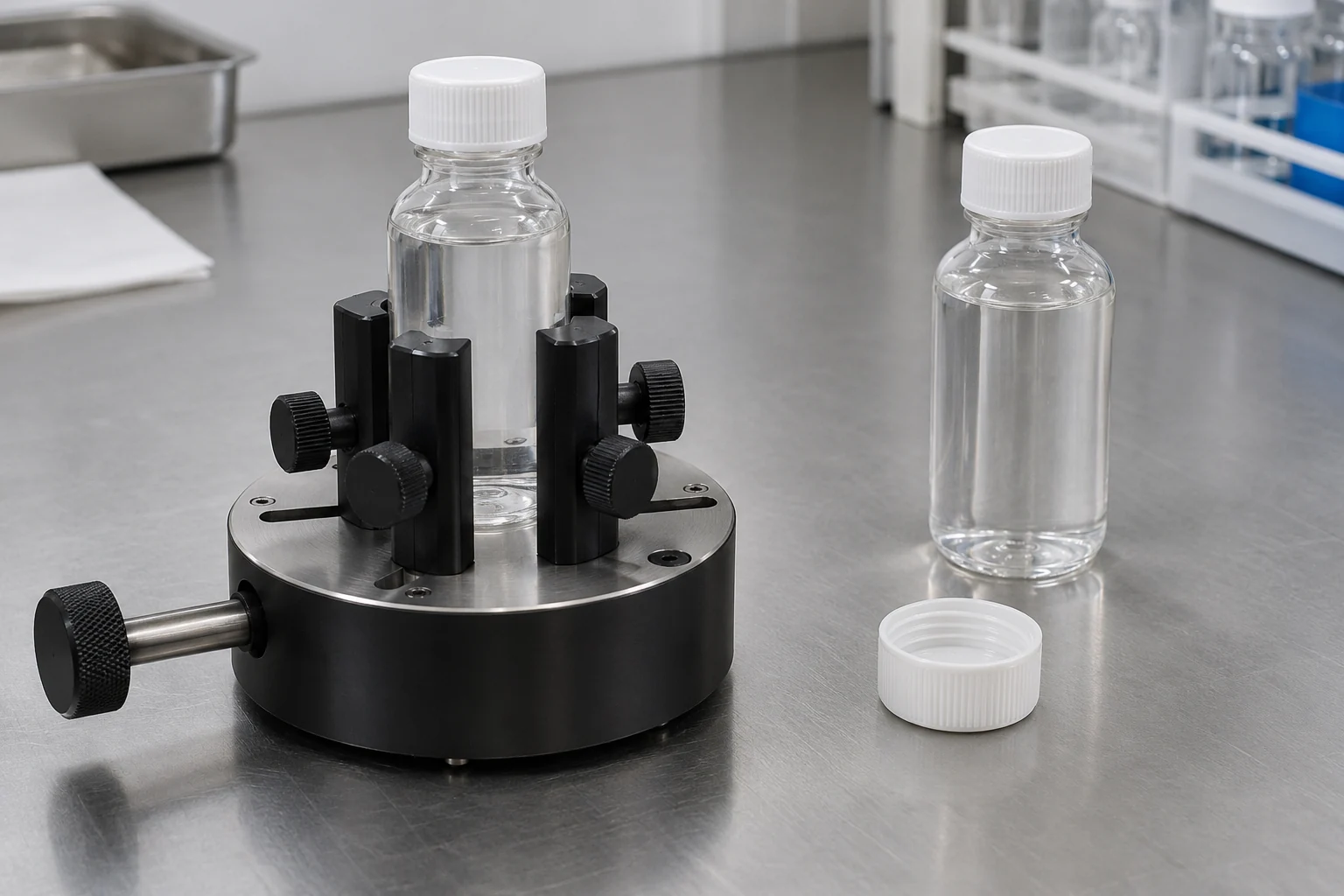
A single “opening torque” that mixes the first turn of the cap with the snap of the tamper band sends the capper the wrong adjustment. Silgan Closures bulletin TAB14, Revision C, issued 22 April 2022, splits those events: removal torque is the initial torque to rotate the closure before the tamper-evident band breaks, and band-break torque is a later peak, taken after the meter is zeroed, when the bridges between the band and the shell break.
The cap torque guide already separates application torque from removal torque and asks you to name the opening endpoint. This page is that endpoint when the endpoint is the band: pull-up, T1, then T2, in the order TAB14 writes for its plastic closures.
Measure the band as its own peak
TAB14 says quality checks on a package run in sequence. For its 2-piece lined closures the example order is pull-up, then removal torque, then band-break torque (optional), then security, before the next sample. Band-break is how the bulletin gauges the tamper-evidence function. It is marked optional. Skipping it is a choice to leave that function unchecked, not a license to fold it into T1.
Pull-up comes first because it is the mechanical relationship of cap thread to bottle thread, read in 1/16 inch steps with the gauge for that diameter. A positive pull-up has the closure index mark to the right of the bottle index mark. A negative pull-up has it to the left. Bottle finishes do not all put the index mark in the same place. TAB14 names three common pull-up mark positions, 0°, 42° and 78°, measured from a fully formed thread, and says the pull-up range changes with that position. Check the bottle before you compare a reading with a range that belonged to a different mark.
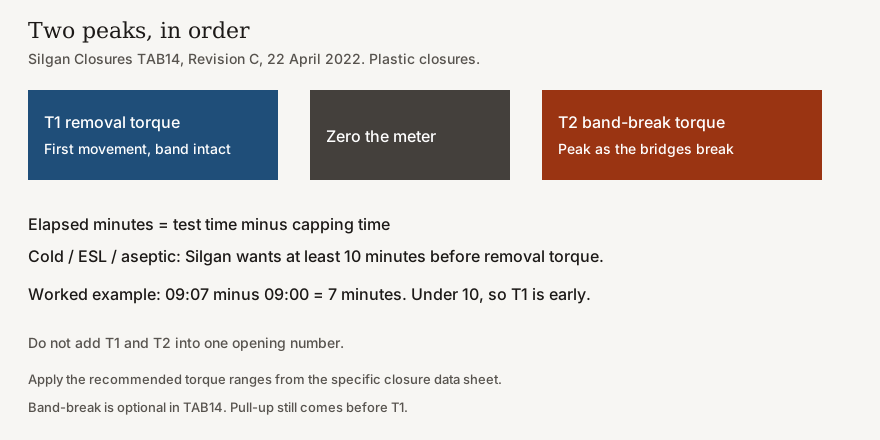
T1 is only the first movement of the closure on the finish, band still intact. TAB14 then says: zero the meter, keep turning until the bridges break, and record that peak as T2.
| Reading | What it is | Dominant failure mode and prevention |
|---|---|---|
| Pull-up | Cap-to-bottle thread position, in 1/16 inch | Comparing a 0° bottle with a range written for a 78° bottle. Prevention: record the mark angle before the shift. TAB14’s gauge check puts a 0° bottle near 0, a 42° bottle near 10, and a 78° bottle near 16 on that gauge. |
| T1 removal torque | First rotation, before the band breaks | Keeping the turn going and calling the later peak T1. Prevention: stop the record at first movement. |
| T2 band-break | Peak after a fresh zero, bridges broken | Forgetting to zero, so T2 still contains T1. Prevention: zero between them, as TAB14 step 1 under band-break states. |
| Security, lined closures | Liner compression after the band is off, read as a pull-up | A negative security value. TAB14 says a negative reading means the package was not properly sealed. The check reapplies the closure to 2 in-lb before that measurement. |
Rule of thumb: If the meter was not zeroed after T1, do not record the next peak as T2. The band reading has to start from zero or it is still the opening event.
Takeaway: Pull-up, T1 and T2 answer three different questions. Adding them produces a number the capper cannot use.

Wait long enough for the reading you claim
TAB14 ties the clock to the fill.
Hot fill: measurements after capping within 1 minute. Measurements after cooling as soon as the packages leave the cooler, and only when product temperature is no greater than 80°F (27°C).
Cold, ESL or aseptic fill: measurements at least 10 minutes after capping for an accurate removal torque.
Formula. Elapsed minutes = test time minus capping time, in the same clock.
Worked example. Capping at 09:00 and a removal-torque check at 09:07 gives 7 minutes. For a cold, ESL or aseptic fill, 7 is under the 10 minutes TAB14 asks for before it calls the removal torque accurate. Hold the sample. A hot-fill sample checked after the cooler at 90°F fails the bulletin’s 80°F ceiling even if the clock looks fine.
TAB14 notes that its recommended removal-torque ranges come from hand opening. An automated opener needs a gauge R&R against that hand method before anyone edits the ranges on the data sheet. Mecmesin’s note on roll-on pilfer-proof wine closures makes the matching point for an aluminum ROPP band: a motorised tester holds a constant rotation speed, and a mandrel that grips evenly around the shell avoids distorting the cap. Their software is described as separating the initial slip, or breakaway, from the value and angle where the tamper-evident band is breached. That is the same two-peak idea as T1 and T2, on a metal roll-on rather than Silgan’s plastic shell. Do not copy a plastic data-sheet range onto an aluminum ROPP, or the reverse.
What application has to leave behind
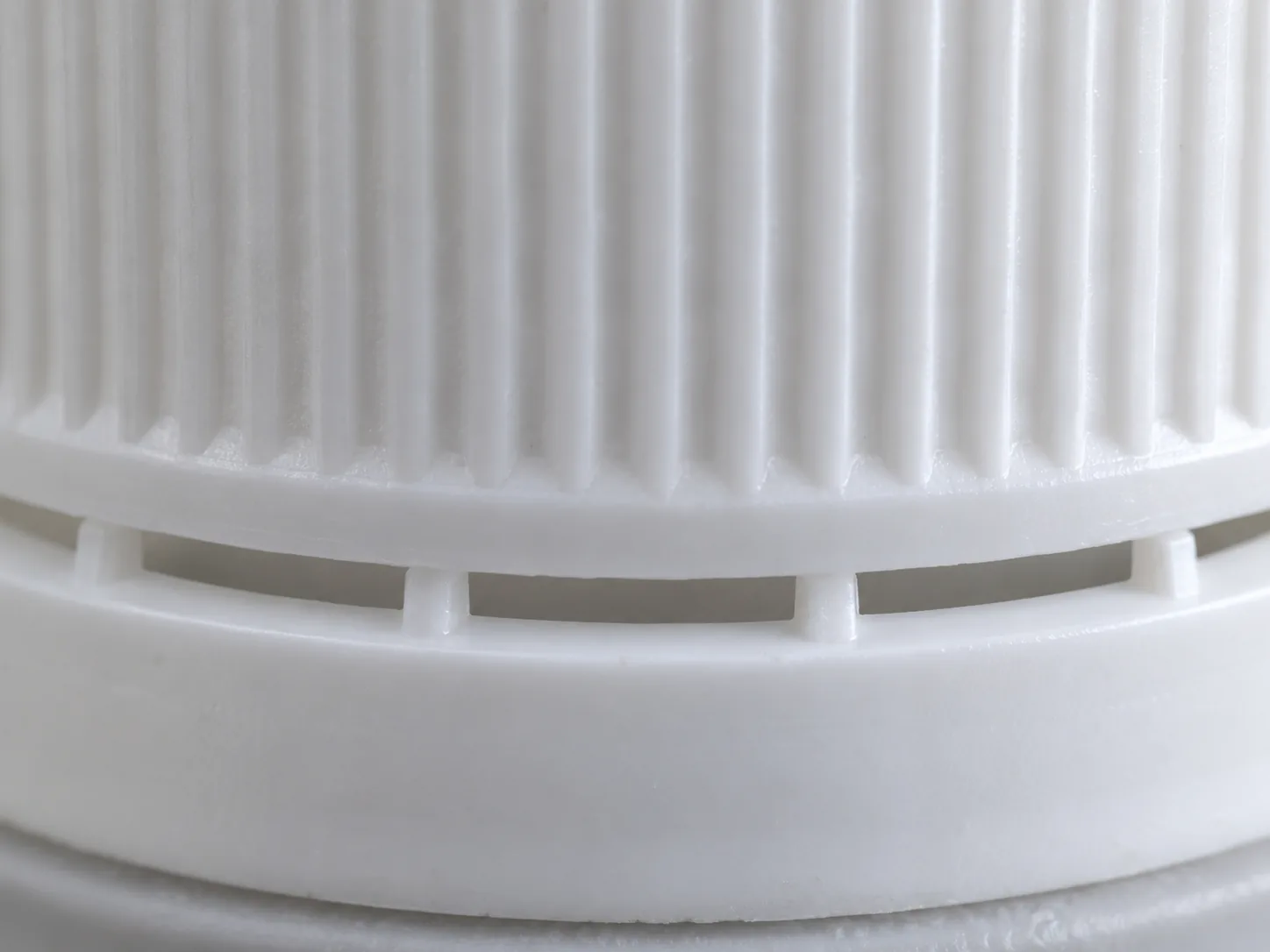
The band only works as evidence if the bridges actually break and the band stays on the bottle. A T2 peak with the band still riding up on the cap is not a broken band. TAB14’s security step tells you to disengage the band completely and remove it from the finish before the liner check. If that cannot be done, the tamper feature did not finish its job, whatever T1 said.
Application angle and head setup belong to the capper, not to this torque sheet. The capping machine guide is where head, bottle and closure are matched before a torque tweak is asked to hide a bad fit, while ROPP capper head adjustment covers 4-roller top-load pressure, thread-roller depth and pilfer-proof tuck-under force calibration on aluminium shells. Neck finish and closure drawings are the bottle-neck match. Wine screw caps with a pilfer band are among the closure types on the wine closure page. Return to closure torque for the difference between the closing input and any later opening measurement.
Blank line for one package
| Field | Guidance | Entry |
|---|---|---|
| Closure and lot | Supplier and cavity or lot | ____ |
| Bottle finish mark | 0°, 42°, 78°, or the angle you measured | ____ |
| Fill type | Hot, cold, ESL, aseptic, or other | ____ |
| Cap time | Clock time | ____ |
| Test time | Clock time | ____ |
| Elapsed minutes | Test minus cap | ____ min |
| Product temperature | Needed for a cooled hot-fill check | ____ |
| Pull-up | 1/16 inch, sign recorded | ____ |
| T1 | First movement only | ____ |
| Meter zeroed | Yes or no, before T2 | ____ |
| T2 | Peak at bridge break, or “not tested” | ____ |
| Band after opening | Dropped on the neck, or still on the cap | ____ |
| Security | Lined closures only, after reapply to 2 in-lb | ____ |
Takeaway: A tamper band is checked by the order of the readings and by where the band sits afterward, not by one torque number that mixes both peaks.